Connect With Us

DTF vs DTG vs Screen Printing vs Embroidery for Hoodies
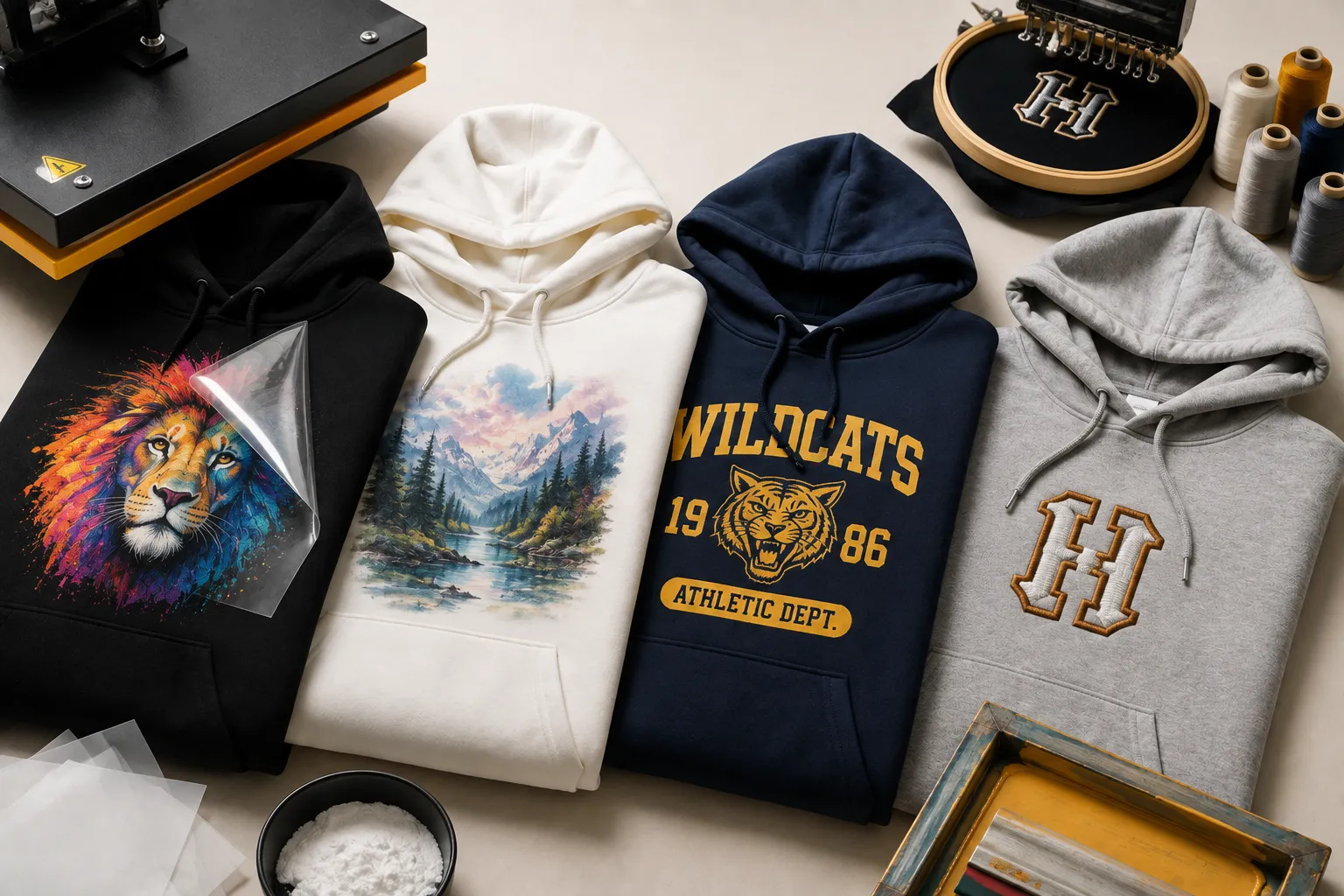
Choosing a hoodie is only half the job when you are creating custom printed hoodies.
You also need to decide how your design will be added to the hoodie.
Should you use DTF printing?
Would DTG printing give you a better result?
Is screen printing better for a large bulk order?
Or should you choose embroidery for a more premium look?
There is no single printing method that is best for every hoodie.
The right option depends on your design, fabric, quantity, colors, print size, budget and the look you want.
This guide explains the four major methods in simple terms so you can make a better decision before ordering custom hoodies.
The Four Main Hoodie Decoration Methods
The four methods covered in this guide are:
- DTF — Direct-to-Film printing
- DTG — Direct-to-Garment printing
- Screen printing
- Embroidery
Each method works differently.
That difference affects the final appearance, feel, durability and production process.
For example, a detailed full-color photograph may work very well with DTF or DTG, while a simple company logo may look excellent with screen printing or embroidery.
So instead of asking, “Which printing method is the best?”, it is better to ask:
“Which printing method is best for my hoodie design?”
What Is DTF Printing?
DTF stands for Direct-to-Film.
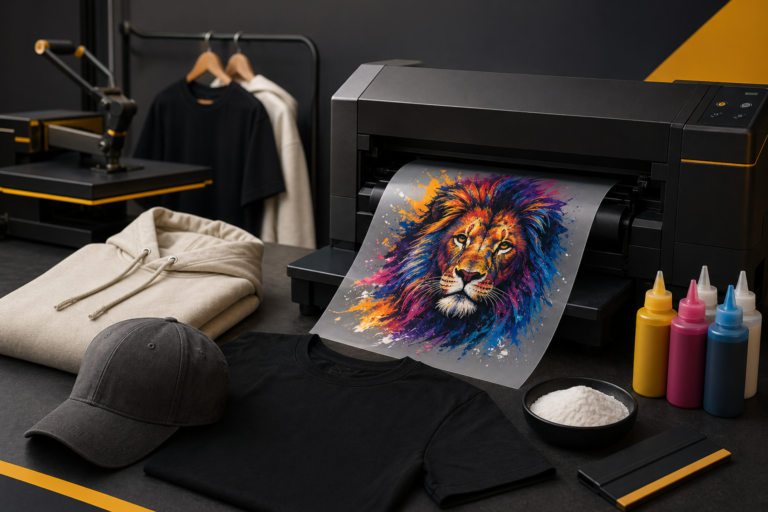
In this process, the design is first printed onto a special transfer film. Adhesive powder is then applied to the printed design, and the transfer is cured using heat.
The finished transfer is then pressed onto the hoodie using a heat press.
In simple terms:
Design → Film → Powder → Heat → Hoodie
The design does not get printed directly onto the hoodie during the first printing stage.
Instead, it is transferred onto the fabric.
DTF has become popular because it can handle detailed, colorful designs and can be used on different types of garments.
What Is Good About DTF?
DTF can be useful when your design has:
- Multiple colors
- Fine details
- Small text
- Illustrations
- Logos
- Photographs
- Gradients
- Complex artwork
It can also be useful when you need relatively small quantities because there is no need to prepare a separate screen for every color.
How Does DTF Feel?
A DTF print usually sits on top of the fabric.
This means you can feel the printed area, especially when the design is large.
The final feel depends on the transfer quality, ink coverage, fabric and production process.
For a small logo, the difference may barely matter.
For a very large design covering much of the hoodie, the print can feel more noticeable.
When Is DTF a Good Choice?
DTF can be a strong option for:
- Small orders
- Medium-size orders
- Full-color designs
- Detailed artwork
- Personalized names and numbers
- Logos with multiple colors
- Designs that need sharp details
It is particularly useful when every hoodie may have a slightly different design.
For example, imagine a college group ordering 30 hoodies where every hoodie has the same main logo but a different name.
DTF can be a practical option for this type of personalization.
What Is DTG Printing?
DTG stands for Direct-to-Garment.
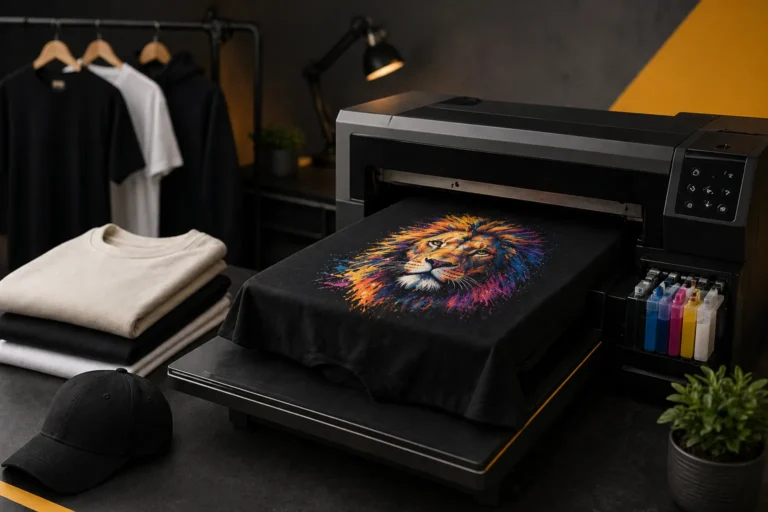
Unlike DTF, the design is printed directly onto the garment using specialized inkjet printing technology.
Think of it like a printer, but instead of printing on paper, it prints on a hoodie.
The garment is placed into the printer, and the printer applies the ink directly to the fabric.
For some garments, especially cotton-based products, DTG can produce detailed and colorful prints with a soft feel.
How Does DTG Work?
The general process is:
Prepare hoodie → Pre-treat if required → Print design → Cure ink → Quality check
Pre-treatment is particularly important for certain garments because it helps the ink bond properly with the fabric.
The hoodie is then printed and heat-cured so that the ink becomes durable.
What Is Good About DTG?
DTG can be excellent for:
- Detailed artwork
- Photographic designs
- Illustrations
- Multiple colors
- Gradients
- Large colorful designs
- Cotton garments
One major advantage is that the ink becomes part of the surface of the fabric rather than creating a separate transfer layer like DTF.
This can create a softer print feel.
What Are the Limitations of DTG?
DTG works best when the garment and fabric are suitable for the process.
Cotton is commonly preferred for DTG because the ink is designed to interact well with the textile fibers.
Polyester and other synthetic fabrics can require different approaches or specialized inks.
This means you should not choose DTG first and worry about the hoodie fabric later.
The fabric and printing method should be selected together.
What Is Screen Printing?
Screen printing is one of the oldest and most widely used garment printing methods.
Instead of using a digital printer, the design is transferred through a prepared screen.
A stencil blocks certain areas of the screen while allowing ink to pass through the areas that form the design.
Ink is then pushed through the screen onto the hoodie.
For a simple design, the process can be very efficient.
How Does Screen Printing Work?
A simplified process looks like this:
Artwork → Screen preparation → Ink application → Curing → Quality check
If a design contains multiple colors, separate screens may be required for different colors.
This means a four-color design can require more preparation than a one-color design.
Why Is Screen Printing Popular?
Screen printing is known for producing strong, bold prints.
It can be particularly effective for:
- Large orders
- Simple designs
- Bold graphics
- Logos
- Text
- Limited-color artwork
- Promotional merchandise
One of its biggest advantages is that the cost per garment can become attractive as the order quantity increases.
The initial setup takes time and effort, but once the screens are prepared, many garments can be printed efficiently.
What Are the Limitations?
Screen printing is not always the most practical option for highly detailed, full-color artwork.
It can require more preparation when the design contains many colors.
It can also be less convenient when every hoodie needs a different design.
For example, printing the same company logo on 500 hoodies is very different from printing 500 different photographs.
The first situation is well suited to screen printing.
The second may be better suited to a digital printing method.
What Is Embroidery?
Embroidery is different from all three printing methods.
It does not use ink.
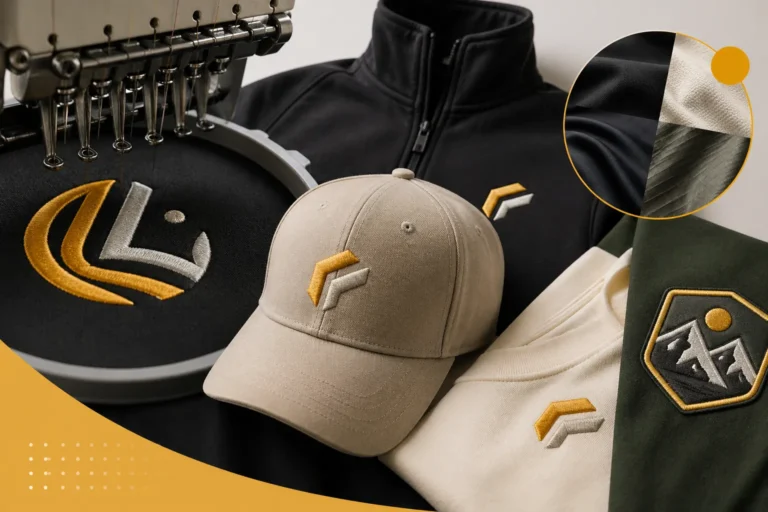
Instead, the design is created using thread stitched directly into the fabric.
A digital embroidery file tells the embroidery machine where to place the stitches.
The machine then creates the design using thread.
This produces a raised, textured appearance.
Why Choose Embroidery?
Embroidery can give a hoodie a more premium and professional appearance.
It works particularly well for:
- Company logos
- Small brand marks
- Team logos
- College logos
- Names
- Monograms
- Premium merchandise
A small embroidered logo on the chest, for example, can look clean and professional.
What Are the Limitations?
Embroidery is not suitable for every type of artwork.
Very small details can be difficult to reproduce because embroidery uses thread rather than ink.
Photographs and complex gradients are also not a natural fit for embroidery.
There is another important consideration.
Embroidery adds physical material to the garment.
A large embroidered design can therefore become heavy or uncomfortable.
For this reason, embroidery is often better for small or medium-sized logos rather than huge front graphics.
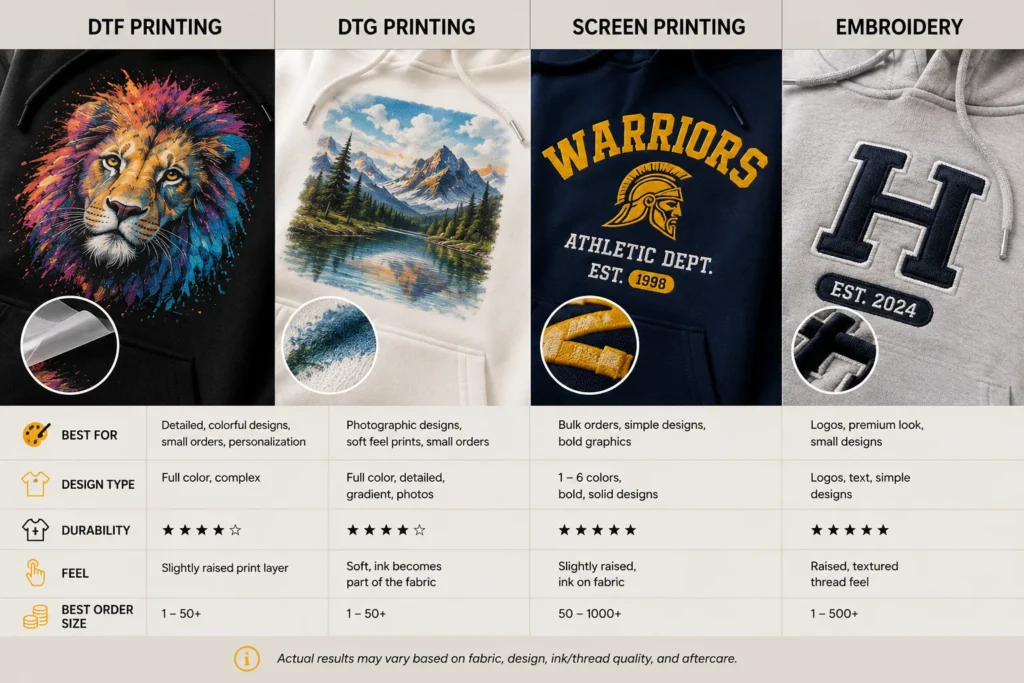
DTF vs DTG vs Screen Printing vs Embroidery
Here is a simple comparison:
| Feature | DTF | DTG | Screen Printing | Embroidery |
|---|---|---|---|---|
| Basic process | Transfer film | Direct ink printing | Ink through screen | Thread stitching |
| Best for | Detailed designs | Detailed artwork | Bulk/simple designs | Logos & premium branding |
| Full-color designs | Excellent | Excellent | Possible | Limited |
| Photographs | Excellent | Excellent | Possible but less practical | Not suitable |
| Small text | Good | Good | Good | Can be difficult if very small |
| Large solid designs | Good | Good | Excellent | Usually not ideal |
| Multiple colors | Excellent | Excellent | More setup | Limited by stitch design |
| Personalized designs | Excellent | Good | Less convenient | Good |
| Small orders | Good | Good | Less efficient | Good |
| Large bulk orders | Good | Good | Excellent | Good |
| Raised texture | Slight print layer | Usually softer | Ink layer | Yes |
| Thread-like finish | No | No | No | Yes |
These are general comparisons. Actual results depend on the garment, artwork, equipment, inks, threads and production quality.
DTF vs DTG: What Is the Difference?
DTF and DTG are both digital printing methods, but they work differently.
DTF prints onto a transfer film first.
DTG prints directly onto the hoodie.
This creates some important differences.
DTF can work across a wider range of fabrics, depending on the materials and process being used.
DTG is particularly attractive when you want a soft, detailed print on a suitable cotton garment.
If your hoodie is polyester, a DTF solution may be more practical.
If your hoodie is a suitable cotton garment and you want a soft, detailed direct print, DTG can be a strong option.
The final decision should be made after considering the actual fabric and artwork.
DTF vs Screen Printing
This is one of the most common comparisons for custom hoodies.
Suppose you have a company logo with three colors.
You want to print it on 500 hoodies.
Screen printing may make sense because the same design is being repeated many times.
Now imagine you need 20 hoodies, each with a different detailed design.
DTF may be more convenient because the artwork can be digitally prepared without creating a complete screen setup for every design.
Choose DTF when:
- You have detailed artwork
- You need many colors
- You have smaller quantities
- Designs vary between garments
- You need personalization
Consider screen printing when:
- You have a large quantity
- The design is simple
- The design uses fewer colors
- You want bold, strong graphics
- The same artwork will be repeated
DTG vs Screen Printing
DTG and screen printing are also very different.
DTG is essentially a digital process.
Screen printing is a physical stencil-based process.
DTG can be excellent for detailed artwork with many colors.
Screen printing can be more efficient for large quantities of simpler designs.
For example:
50 hoodies with a detailed illustration:
DTG can be worth considering.
500 hoodies with a two-color company logo:
Screen printing may be more efficient.
Again, the actual quote depends on the design, garment and production requirements.
DTF vs Embroidery
DTF and embroidery are often chosen for completely different visual effects.
DTF gives you a printed design.
Embroidery gives you a stitched design.
If you want a colorful graphic covering the back of a hoodie, DTF may be more suitable.
If you want a small company logo on the chest, embroidery may give you the premium look you want.
For example:
Startup hoodie:
Small embroidered logo on the chest.
College hoodie:
Large printed graphic on the back.
Sports team hoodie:
Embroidered team logo plus printed player details.
There is no reason you cannot combine methods on the same garment when the design requires it.
Which Printing Method Is Most Durable?
This question is more complicated than it appears.
People often ask:
“Which one lasts the longest?”
But print durability depends on much more than the printing method.
It can depend on:
- Fabric quality
- Ink or thread quality
- Production process
- Curing
- Print size
- Washing method
- Washing temperature
- Detergent
- Garment construction
- Frequency of washing
A poorly produced screen print can perform worse than a properly produced DTF print.
Likewise, poor embroidery can damage the appearance of a garment even though embroidery itself is known for durability.
The quality of production matters.
Which Method Is Best for Different Hoodie Designs?
Let’s make the decision easier.
Company Logo
Best options: Embroidery, screen printing or DTF.
For a small professional logo, embroidery can look premium.
For a larger logo, screen printing or DTF may be more suitable.
College Hoodie
Best options: Screen printing, DTF or embroidery.
A large back design can work well with screen printing or DTF.
A small college emblem can work well with embroidery.
Photographic Design
Best options: DTF or DTG.
These methods are better suited to detailed images with many colors and shades.
Simple Text
Best options: Screen printing, DTF or embroidery.
The best choice depends on size, quantity and the desired appearance.
Personalized Names and Numbers
Best options: DTF or embroidery.
These methods are convenient when different hoodies need different names or numbers.
Premium Minimalist Hoodie
Best option: Embroidery.
A small embroidered logo can create a clean, understated appearance.
Does Hoodie Fabric Affect the Printing Method?
Absolutely.
This is one of the most important things buyers should understand.
The hoodie fabric should be considered before choosing the printing method.
For example, TrendyDice lists multiple fabric options for custom hoodies, including 100% cotton, bio-wash cotton, 240 GSM oversized cotton and polyester. The company also notes that fabric choice affects comfort, durability and print quality.
Different fabrics can react differently to heat, ink and printing processes.
That is why a professional supplier should consider:
Fabric + GSM + color + artwork + printing method
as one complete decision.
Does Hoodie Color Affect Printing?
Yes.
The color of the hoodie can influence the printing process and final appearance.
A white design on a black hoodie is different from a black design on a white hoodie.
Dark garments may require an appropriate base layer or printing approach to make colors appear bright.
This is particularly important for detailed artwork.
A design that looks perfect on a computer screen may look different when printed on a dark fabric.
This is why a print proof or sample can be valuable for important orders.
Does Design Size Matter?
Yes.
A small chest logo and a large back graphic have different production requirements.
A small logo may require less ink or fewer stitches.
A large print covers more fabric and can change the feel and appearance of the hoodie.
Large embroidered designs can also become heavy.
When planning your hoodie, consider:
- Front print
- Back print
- Sleeve print
- Chest logo
- Print dimensions
- Number of colors
- Personalized elements
The placement should be decided before production.
Which Printing Method Is Cheapest?
There is no universal cheapest method.
The final price can depend on:
- Number of hoodies
- Fabric
- GSM
- Printing method
- Number of colors
- Print size
- Number of print locations
- Personalization
- Delivery timeline
For large quantities with the same simple design, screen printing can become cost-effective because the setup is spread across many garments.
For smaller quantities or highly detailed designs, digital methods such as DTF can make more sense.
Embroidery pricing can also vary based on stitch count, design size and quantity.
This is why asking only for a “price per hoodie” without sharing the artwork can lead to an incomplete comparison.
How to Choose the Right Hoodie Printing Method
Use this simple process.
Step 1: Look at Your Design
Is it:
- A simple logo?
- A photograph?
- A detailed illustration?
- Text?
- Names and numbers?
Start here.
Step 2: Check Your Hoodie Fabric
Is it:
- Cotton?
- Polyester?
- A blend?
- Fleece?
- French terry?
The fabric can affect the appropriate printing process.
Step 3: Decide the Quantity
Are you ordering:
- 1–10?
- 20–50?
- 100?
- 500+?
Quantity can significantly change which method is practical.
Step 4: Decide the Look
Do you want:
- Soft printed artwork?
- Bold graphic printing?
- A premium stitched logo?
- A textured design?
The visual goal matters.
Step 5: Consider the Print Location
A chest logo, full front print, back graphic and sleeve print can have different requirements.
Step 6: Ask for a Sample When Needed
For a large or important order, seeing an actual sample can help you evaluate:
- Fabric
- Fit
- Print quality
- Color
- Print feel
- Stitching
- Overall finish
What Printing Method Should You Choose?
Here is the simplest way to think about it:
Choose DTF when you need detailed, colorful designs, personalization or flexibility across smaller and medium orders.
Choose DTG when you want detailed direct-to-garment printing on a suitable fabric, especially cotton-based garments.
Choose screen printing when you have repeated designs, simpler graphics and larger quantities.
Choose embroidery when you want a premium stitched appearance, especially for logos and smaller branding elements.
And sometimes, the best answer is a combination.
Custom Hoodies Need More Than Just Good Printing
A great print cannot completely fix a poor-quality hoodie.
The final product depends on several parts working together:
- Hoodie fabric
- GSM
- Fit
- Stitching
- Color
- Printing method
- Artwork
- Print placement
- Production quality
This is why it is better to choose the hoodie and printing method together rather than deciding on the printing technique first.
TrendyDice offers custom hoodie styles including pullover, zipper and oversized hoodies, along with different fabric options and printing methods such as DTF, DTG, screen printing, puff printing and embroidery.
Final Thoughts
DTF, DTG, screen printing and embroidery all have their own strengths.
There is no universal winner.
DTF is flexible and well suited to detailed, colorful and personalized designs.
DTG can produce detailed prints with a soft feel on suitable garments.
Screen printing is a strong choice for repeated designs and larger quantities.
Embroidery creates a textured, premium appearance that works especially well for logos and branding.
The best choice depends on your design, hoodie fabric, quantity, print size, budget and desired finish.
If you are ordering custom hoodies for a college, corporate team, event, sports group or clothing brand, do not choose the printing method based only on price.
First decide what you want the finished hoodie to look and feel like.
Then match the fabric, GSM and printing method to that requirement.
If you are ready to create your own hoodies, explore TrendyDice custom hoodies printed. You can choose your hoodie style, fabric, design and printing approach based on your specific requirement.