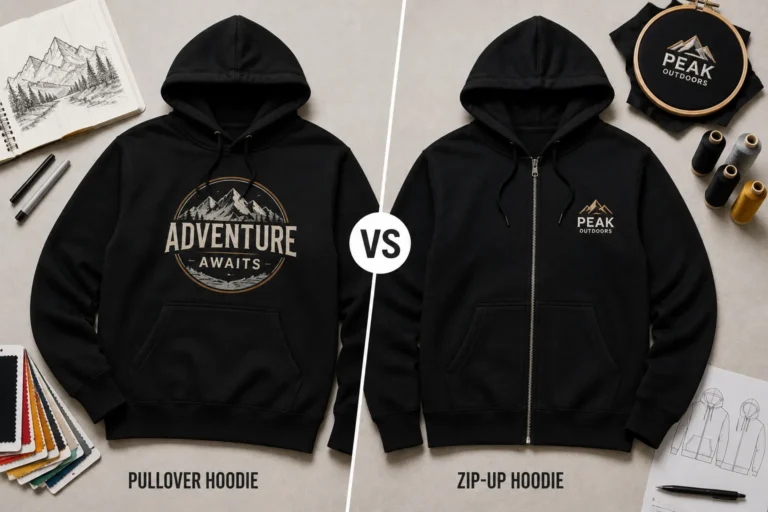
Connect With Us

How to Choose the Right Hoodie for Bulk Orders: A Buyer’s Guide
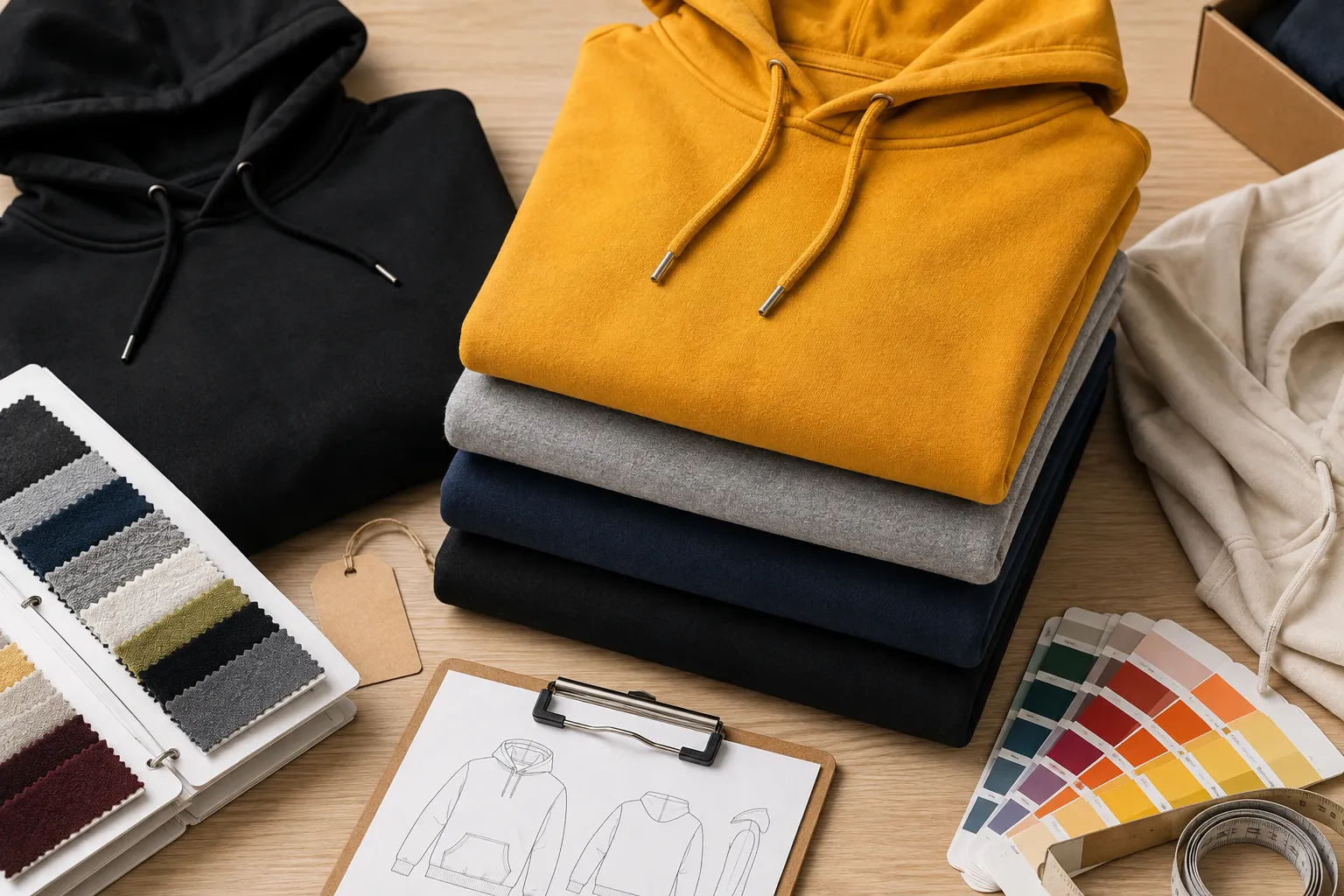
Buying one hoodie is easy.
Buying 50, 100, 500 or 1,000 hoodies is a completely different job.
When you buy one hoodie, you can simply check whether you like the fabric, fit and design.
With a bulk order, one small mistake gets repeated across every piece.
If the fabric is too thin, all the hoodies will be too thin.
If the sizing is wrong, dozens or hundreds of people may receive the wrong fit.
If the print quality is poor, the problem affects the entire order.
This is why choosing a hoodie for a bulk order requires more than comparing prices.
You need to look at the fabric, GSM, fit, sizing, color, printing method, stitching, quantity, samples, quality control and delivery timeline together.
This guide explains what to check before placing a bulk hoodie order.
Why Bulk Hoodie Orders Need More Planning
A bulk hoodie order is usually made for a specific purpose.
For example:
- College merchandise
- Corporate team apparel
- Sports teams
- Events
- Startups
- Brand merchandise
- Promotional campaigns
- School groups
- Family or community events
- Clothing brands
Each use case can require a different hoodie.
A corporate team may want a comfortable medium-weight hoodie that employees can wear regularly.
A streetwear brand may want a heavyweight oversized hoodie.
A sports team may care more about mobility and durability.
A college group may want a balance between price, comfort and appearance.
So there is no single hoodie that is automatically best for every bulk order.
The goal is to choose the right hoodie for the people who will actually wear it.
1. Start With the Purpose of the Hoodie
Before discussing GSM or printing, decide why you are buying the hoodies.
Ask one simple question:
Where and how will these hoodies be used?
College Hoodies
College hoodies are usually expected to be:
- Comfortable
- Stylish
- Affordable
- Easy to wear
- Suitable for students
If the hoodies are for a winter college event, a warmer fleece option may make sense.
If they are mainly for indoor events or mild weather, a lighter fabric can be more practical.
Corporate Hoodies
Corporate hoodies are often used for:
- Employee merchandise
- Team outings
- Company events
- Conferences
- Promotional campaigns
- Employee gifts
Here, comfort and professional appearance are important.
A medium-weight cotton or cotton-blend hoodie can often provide a good balance.
Sports Team Hoodies
Sports hoodies may need:
- Good mobility
- Durability
- Comfortable fit
- Suitable moisture management
- Easy care
The requirements can also change depending on whether the hoodie is worn during activity, during warm-up or simply before and after the game.
Clothing Brands
If you are buying hoodies for your own clothing brand, the decision becomes even more important.
You need to think about:
- Brand positioning
- Fabric quality
- GSM
- Fit
- Stitching
- Color consistency
- Print quality
- Packaging
- Repeatability between batches
A hoodie that is acceptable for a one-time event may not be good enough for a brand that plans to sell the same product repeatedly.
2. Understand Hoodie GSM
One of the first specifications you should ask for is GSM.
GSM means grams per square meter.
It tells you the weight of the fabric.
Generally, a higher GSM means a heavier and more substantial fabric, although GSM alone does not determine quality or warmth.
For example:
- 180 GSM → lightweight
- 240 GSM → light to medium
- 300 GSM → medium-heavy
- 400 GSM → heavyweight
But do not make the mistake of thinking:
Higher GSM = Better Hoodie
That is not always true.
A 240 GSM hoodie may be the right choice for a mild climate, while a 400 GSM hoodie may be unnecessarily heavy.
The correct GSM depends on:
- Weather
- Fabric
- Intended use
- Fit
- Budget
- Desired appearance
If you want a deeper explanation of hoodie weight, see TrendyDice’s Hoodie GSM guide.
3. Choose the Right Fabric
After GSM, look at the fabric.
Common hoodie materials include:
- Cotton
- Polyester
- Cotton-polyester blends
- Fleece
- French terry
These materials do not behave in exactly the same way.
Cotton
Cotton is popular because it can provide:
- Softness
- Comfort
- Breathability
- Natural feel
However, cotton can shrink if it has not been properly processed or pre-shrunk.
Polyester
Polyester is known for:
- Durability
- Shape retention
- Lower shrinkage
- Faster drying
It can be useful for sports and performance-oriented applications.
Cotton-Polyester Blends
Blends combine different fibers to balance their properties.
For example, cotton can provide comfort while polyester can improve durability and shape retention.
This can make blends a practical choice for many bulk orders.
Fleece
Fleece is commonly used when warmth is important.
The inner surface is often brushed, creating a soft surface that can help provide insulation.
French Terry
French terry normally has loops on the inside rather than a heavily brushed surface.
It can provide a lighter and more breathable feel than a comparable fleece construction.
There is no universally best fabric.
The best choice depends on the purpose of your order.
4. Consider the Climate
The same hoodie may not work equally well across different parts of India.
This is especially important for large organizations ordering hoodies for people in different cities.
Think about:
How cold will it actually be when the hoodies are used?
If the hoodie is mainly for mild weather, an extremely heavy fabric can become uncomfortable.
If it is intended for colder winter conditions, a heavier fleece construction may be more suitable.
For example, a hoodie intended for a winter event in North India may have different requirements from one intended for year-round use in a warmer region.
This is why choosing a hoodie based only on its appearance can be risky.
5. Choose the Right Hoodie Style
Fabric is not the only decision.
You also need to decide on the hoodie style.
Common options include:
Pullover Hoodie
The classic hoodie style.
It has a clean front and is particularly suitable when you want a large front print.
Zip-Up Hoodie
A zip-up hoodie can be easier to put on and remove.
It is useful for:
- Corporate teams
- Sports teams
- Outdoor events
- Layering
However, the zipper creates a central area where a large front design may not work as well.
Oversized Hoodie
Oversized hoodies have become popular in streetwear.
They typically use a wider body, dropped shoulders and a looser fit.
If you are ordering oversized hoodies, do not simply order your normal size.
The measurements can be very different from regular-fit garments.
6. Never Ignore the Size Chart
Size is one of the biggest potential problems in a bulk clothing order.
Do not assume that:
S = S everywhere.
Different manufacturers can have different measurements for the same nominal size.
One brand’s medium can fit differently from another brand’s medium.
This is especially important with:
- Oversized hoodies
- Streetwear fits
- Unisex hoodies
- Custom garments
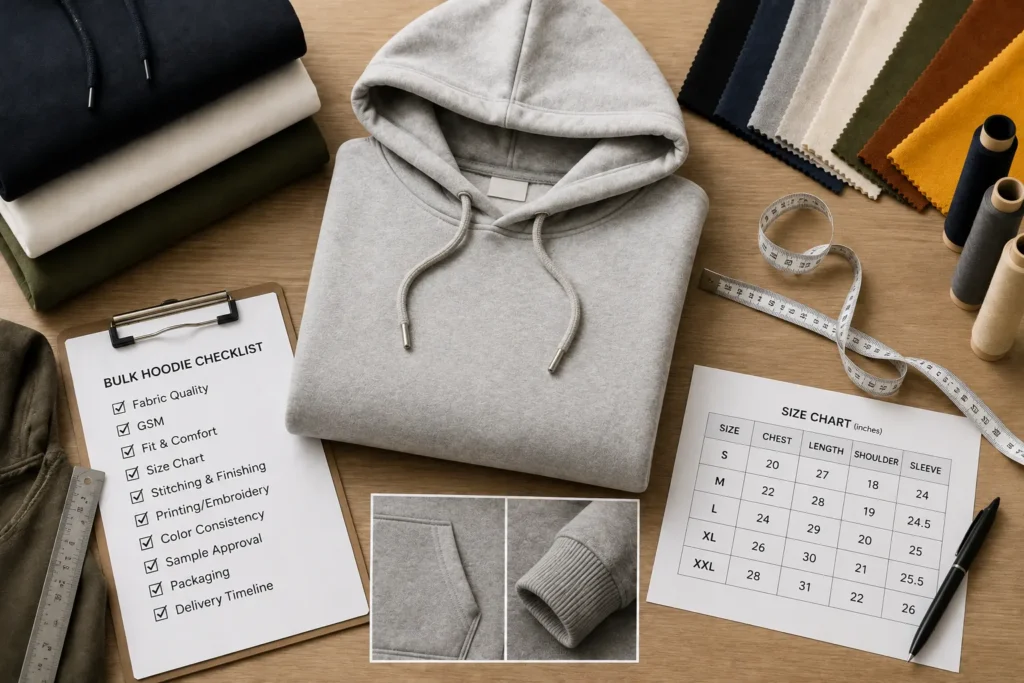
Ask for the actual measurement chart.
Check:
- Chest width
- Body length
- Shoulder width
- Sleeve length
- Hood dimensions
For an important bulk order, it is much safer to check an actual sample than to select sizes only from a generic S/M/L label.
7. Order a Sample Before the Bulk Order
This is one of the most important rules.
Do not approve a large hoodie order without seeing the actual product whenever sampling is possible.
A product photograph cannot tell you everything.
A sample lets you check:
- Fabric feel
- Actual GSM
- Fit
- Color
- Hood construction
- Stitching
- Ribbing
- Pocket construction
- Print quality
- Print placement
- Overall finish
Industry buyer guidance also recommends requesting samples before committing to a large hoodie order because the sample lets you assess material quality, stitching and feel before the full production run.
The sample should become your reference point for the final order.
8. Check Fabric Quality, Not Just Fabric Type
Saying “100% cotton” does not automatically mean the hoodie is high quality.
Two cotton hoodies can feel completely different.
The difference can come from:
- Yarn quality
- Knitting
- Fabric density
- Finishing
- GSM
- Construction
- Shrinkage control
The same applies to polyester and blends.
Therefore, do not ask only:
“Is it cotton?”
Ask:
“What cotton, what GSM and how is the fabric finished?”
That gives you much more useful information.
9. Check Shrinkage
Shrinkage matters because the hoodie you receive before washing may not be exactly the same after washing.
Cotton is particularly important here because it can shrink if it has not been properly treated.
For a bulk order, ask about:
- Pre-shrinking
- Expected shrinkage
- Washing instructions
- Sample wash testing
If possible, wash the sample before approving production.
This gives you a better idea of how the actual garment may behave.
10. Check Stitching and Construction
A hoodie can have excellent fabric and printing but still feel poor if the construction is weak.
Look carefully at:
Shoulder seams
Are they even and properly finished?
Sleeve seams
Are the stitches consistent?
Ribbing
Do the cuffs and waistband feel strong?
Hood
Does it hold its shape?
Kangaroo pocket
Are the seams clean?
Drawstrings
Are they properly finished?
General stitching
Look for:
- Loose threads
- Uneven seams
- Puckering
- Broken stitches
- Poor finishing
For a large order, these small details become important because you are buying many identical garments.
11. Choose the Printing Method Before Finalizing the Hoodie
If the hoodies will be customized, the printing method needs to be considered together with the hoodie fabric.
Common options include:
- DTF
- DTG
- Screen printing
- Embroidery
The best method depends on:
- Artwork
- Fabric
- Number of colors
- Quantity
- Print size
- Personalization
- Desired finish
For example, a large, simple design repeated across 500 hoodies may be well suited to screen printing.
A detailed, colorful design may be better suited to a digital method such as DTF or DTG.
A small company logo may look particularly good as embroidery.
Do not choose the printing method simply because it is the cheapest.
The printing process is part of the final product.
12. Think About the Print Location
Where will the design go?
Common locations include:
- Left chest
- Center chest
- Full front
- Full back
- Sleeve
- Hood
- Pocket area
The hoodie design should be created around the actual garment.
For example, a large design on a zip-up hoodie may be interrupted by the zipper.
A pocket can also affect the placement of a front print.
If you are using embroidery, very large designs may add unnecessary weight and texture.
Therefore, decide the print location before production.
13. Check Color Consistency
Color consistency becomes very important in bulk orders.
Imagine ordering 300 black hoodies and receiving slightly different shades of black.
Or imagine ordering a corporate hoodie where the brand color is supposed to be consistent but varies from batch to batch.
This can affect the professional appearance of the entire order.
For important branding projects, approve the exact garment color and print colors before production.
A physical sample is particularly useful here.
14. Think About the Number of Sizes
Before ordering, collect the expected size requirements.
For example:
| Size | Quantity |
|---|---|
| S | 20 |
| M | 45 |
| L | 60 |
| XL | 40 |
| XXL | 15 |
Do not simply order equal quantities of every size unless you have a specific reason.
For employee, college or team orders, collect size information beforehand.
For a retail brand, use your expected customer size distribution.
The size mix can have a major effect on whether you end up with excess inventory.
15. Check the Minimum Order Quantity
Different suppliers may have different minimum order requirements.
Some may accept very small quantities.
Others may require a larger order for certain fabrics, colors or custom manufacturing.
Before finalizing your design, ask:
- What is the minimum quantity?
- Is the minimum quantity per design?
- Is it per color?
- Is it per size?
- Can multiple designs be combined?
- Is there a different minimum for custom manufacturing?
This prevents surprises later.
16. Understand What Actually Changes the Price
The cheapest hoodie is not always the cheapest bulk order.
Your final cost can depend on:
- Fabric
- GSM
- Hoodie style
- Quantity
- Number of colors
- Printing method
- Print size
- Number of print locations
- Embroidery stitch count
- Packaging
- Delivery
- Customization
- Timeline
For example, a basic hoodie with a small one-color logo will have a very different production requirement from a heavyweight oversized hoodie with a large full-color back print.
When comparing suppliers, compare the same specification.
Otherwise, you may be comparing completely different products.
17. Ask What Is Included in the Quote
This is a simple step that can prevent confusion.
When a supplier gives you a price, ask what the price includes.
For example:
- Hoodie
- Printing
- Embroidery
- Design setup
- Packaging
- GST
- Delivery
- Sampling
- Individual packing
A quote that looks cheaper may not include the same services.
Always compare the final landed cost, not just the headline price.
18. Check the Production Timeline
Bulk hoodie production takes time.
The timeline can include:
Design approval → Sampling → Material preparation → Production → Printing → Quality check → Packing → Delivery
Do not leave the order until the last few days before your event.
Ask for a realistic timeline and include some buffer.
This is especially important when the hoodies are needed for:
- College fests
- Corporate events
- Sports tournaments
- Product launches
- Campaigns
- Seasonal sales
A hoodie arriving two days after the event is not useful, even if the quality is excellent.
19. Ask About Quality Control
For a large order, quality control should happen before the hoodies are packed and dispatched.
A basic inspection can check:
- Fabric
- GSM
- Color
- Size
- Stitching
- Print placement
- Print quality
- Missing prints
- Spelling
- Quantity
For customized apparel, also check the artwork carefully.
A single spelling mistake in a company name or event title can make an entire batch unusable.
20. Approve a Final Sample or Reference
For large orders, it is useful to have one approved reference sample.
This sample can establish:
- Fabric
- Color
- Fit
- Size
- Printing
- Artwork placement
- Embroidery
- Finishing
The production team can then use the approved sample as the reference for the bulk order.
This is particularly useful when the order is large enough that consistency matters.
A Simple Bulk Hoodie Buying Checklist
Before you approve the order, check all of these:
Hoodie
- Hoodie style selected
- Fabric selected
- GSM confirmed
- Fit confirmed
- Size chart checked
- Color approved
Quality
- Sample checked
- Stitching checked
- Hood checked
- Ribbing checked
- Shrinkage considered
- Washing instructions confirmed
Customization
- Artwork finalized
- Printing method selected
- Print size confirmed
- Print location confirmed
- Colors approved
- Spelling checked
Order
- Quantity confirmed
- Size-wise quantities confirmed
- MOQ confirmed
- Final price confirmed
- GST/taxes clarified
- Delivery cost clarified
- Production timeline confirmed
- Delivery date confirmed
Final approval
- Sample approved
- Final artwork approved
- Final color approved
- Bulk production authorized
What Hoodie Should You Choose?
There is no single answer.
Instead, match the hoodie to the requirement.
For College Merchandise
Look for:
Comfort + reasonable GSM + attractive fit + good printing + controlled cost
For Corporate Merchandise
Look for:
Comfort + professional appearance + durability + consistent branding
For Sports Teams
Look for:
Mobility + durability + suitable fabric + practical printing
For Premium Streetwear
Look for:
Heavyweight fabric + strong construction + distinctive fit + high-quality finishing
For Promotional Orders
Look for:
Cost efficiency + acceptable comfort + reliable printing + consistent production
For a Clothing Brand
Look for:
Fabric quality + fit + GSM + consistency + premium finishing + repeatability
The Biggest Mistakes to Avoid
Here are some of the most common mistakes buyers can make.
Choosing Only by Price
A cheaper hoodie may use thinner fabric, weaker construction or lower-quality printing.
Compare specifications, not just price.
Choosing the Highest GSM
Higher GSM is not automatically better.
Choose according to climate, use and desired fit.
Skipping the Sample
A photograph cannot tell you everything.
Always inspect the actual hoodie when possible.
Ignoring the Size Chart
S, M, L and XL are not universal measurements.
Check actual garment dimensions.
Choosing the Printing Method Too Late
The fabric and artwork can affect the suitable printing process.
Decide the printing approach before production.
Not Checking the Final Artwork
One small spelling mistake can affect an entire bulk order.
Approve the final artwork carefully.
Ordering Too Close to the Event
Production, quality checks and delivery all take time.
Keep a buffer.
Should You Choose One Hoodie for Everyone?
Not necessarily.
For some bulk orders, having one hoodie specification keeps things simple.
But different groups may have different requirements.
For example, a company could use:
- A lighter hoodie for general employees
- A premium heavyweight hoodie for management
- An embroidered version for senior teams
- A printed version for an event
However, using multiple specifications also increases complexity.
For most straightforward bulk orders, keeping the core hoodie specification consistent can make production and quality control easier.
Why Sampling Is More Important Than the Product Photo
This deserves repeating.
A product photograph can show you:
- Color
- General shape
- Design
- Styling
But it cannot reliably show you:
- Actual fabric weight
- Hand feel
- Stitch strength
- Shrinkage
- Print texture
- Fit on your target wearer
This is why experienced bulk buyers use samples before committing to large quantities. A sample allows you to test the product under real conditions instead of relying only on a supplier’s description.
How to Compare Two Hoodie Suppliers
Suppose Supplier A offers a hoodie for ₹650.
Supplier B offers one for ₹720.
It may be tempting to choose Supplier A immediately.
But compare:
| Specification | Supplier A | Supplier B |
|---|---|---|
| Fabric | ? | ? |
| GSM | ? | ? |
| Fit | ? | ? |
| Printing | ? | ? |
| Sample | ? | ? |
| Stitching | ? | ? |
| Packaging | ? | ? |
| Delivery | ? | ? |
| GST | ? | ? |
| Final cost | ? | ? |
You may discover that the ₹720 option includes something the cheaper quote does not.
The correct comparison is always like-for-like.
The Right Way to Place a Bulk Hoodie Order
A good bulk hoodie order should follow a simple process:
1. Define the purpose
Know who will wear the hoodies and where they will use them.
2. Select the fabric
Choose cotton, polyester, a blend, fleece or French terry according to the requirement.
3. Select GSM
Choose the appropriate weight rather than automatically choosing the highest GSM.
4. Select the fit and style
Decide between pullover, zip-up, oversized or another style.
5. Finalize the artwork
Prepare the actual design that will go on the hoodie.
6. Select the printing method
Match DTF, DTG, screen printing or embroidery to the design and quantity.
7. Approve a sample
Check the actual hoodie.
8. Confirm the size breakdown
Finalize the quantity required in every size.
9. Confirm the complete price
Make sure all costs are understood.
10. Approve production
Only after the important specifications have been checked.
Final Thoughts
A bulk hoodie order should never be treated as simply:
“I need 100 hoodies. Give me the cheapest price.”
The better approach is to define the complete specification first.
You need to consider:
Purpose → Fabric → GSM → Fit → Size → Color → Printing → Quality → Quantity → Timeline → Price
A good hoodie is one where all of these factors work together.
For a college, company, sports team or event, the priority may be finding the right balance between comfort, appearance and cost.
For a clothing brand, consistency and product quality may matter more.
For a premium streetwear collection, fabric weight, fit and finishing may be the most important factors.
And for every bulk order, sampling before production is one of the safest steps you can take.
If you are looking for hoodies with custom designs, logos or branding, you can explore TrendyDice’s custom printed hoodies and discuss the appropriate hoodie style, fabric, GSM and printing method for your requirement.
The right bulk hoodie is not necessarily the cheapest one or the heaviest one.
It is the one that gives you the right combination of quality, comfort, appearance, printing and value for the people who will actually wear it.
Slug: how-to-choose-right-hoodie-for-bulk-orders
SEO Title: How to Choose the Right Hoodie for Bulk Orders: Buyer’s Guide
Meta Description: Buying hoodies in bulk? Learn how to choose the right fabric, GSM, fit, size, printing method, quality, color and supplier before placing a large order.
x
Buying one hoodie is easy.
Buying 50, 100, 500 or 1,000 hoodies is a completely different job.
When you buy one hoodie, you can simply check whether you like the fabric, fit and design.
With a bulk order, one small mistake gets repeated across every piece.
If the fabric is too thin, all the hoodies will be too thin.
If the sizing is wrong, dozens or hundreds of people may receive the wrong fit.
If the print quality is poor, the problem affects the entire order.
This is why choosing a hoodie for a bulk order requires more than comparing prices.
You need to look at the fabric, GSM, fit, sizing, color, printing method, stitching, quantity, samples, quality control and delivery timeline together.
This guide explains what to check before placing a bulk hoodie order.
Why Bulk Hoodie Orders Need More Planning
A bulk hoodie order is usually made for a specific purpose.
For example:
- College merchandise
- Corporate team apparel
- Sports teams
- Events
- Startups
- Brand merchandise
- Promotional campaigns
- School groups
- Family or community events
- Clothing brands
Each use case can require a different hoodie.
A corporate team may want a comfortable medium-weight hoodie that employees can wear regularly.
A streetwear brand may want a heavyweight oversized hoodie.
A sports team may care more about mobility and durability.
A college group may want a balance between price, comfort and appearance.
So there is no single hoodie that is automatically best for every bulk order.
The goal is to choose the right hoodie for the people who will actually wear it.
1. Start With the Purpose of the Hoodie
Before discussing GSM or printing, decide why you are buying the hoodies.
Ask one simple question:
Where and how will these hoodies be used?
College Hoodies
College hoodies are usually expected to be:
- Comfortable
- Stylish
- Affordable
- Easy to wear
- Suitable for students
If the hoodies are for a winter college event, a warmer fleece option may make sense.
If they are mainly for indoor events or mild weather, a lighter fabric can be more practical.
Corporate Hoodies
Corporate hoodies are often used for:
- Employee merchandise
- Team outings
- Company events
- Conferences
- Promotional campaigns
- Employee gifts
Here, comfort and professional appearance are important.
A medium-weight cotton or cotton-blend hoodie can often provide a good balance.
Sports Team Hoodies
Sports hoodies may need:
- Good mobility
- Durability
- Comfortable fit
- Suitable moisture management
- Easy care
The requirements can also change depending on whether the hoodie is worn during activity, during warm-up or simply before and after the game.
Clothing Brands
If you are buying hoodies for your own clothing brand, the decision becomes even more important.
You need to think about:
- Brand positioning
- Fabric quality
- GSM
- Fit
- Stitching
- Color consistency
- Print quality
- Packaging
- Repeatability between batches
A hoodie that is acceptable for a one-time event may not be good enough for a brand that plans to sell the same product repeatedly.
2. Understand Hoodie GSM
One of the first specifications you should ask for is GSM.
GSM means grams per square meter.
It tells you the weight of the fabric.
Generally, a higher GSM means a heavier and more substantial fabric, although GSM alone does not determine quality or warmth.
For example:
- 180 GSM → lightweight
- 240 GSM → light to medium
- 300 GSM → medium-heavy
- 400 GSM → heavyweight
But do not make the mistake of thinking:
Higher GSM = Better Hoodie
That is not always true.
A 240 GSM hoodie may be the right choice for a mild climate, while a 400 GSM hoodie may be unnecessarily heavy.
The correct GSM depends on:
- Weather
- Fabric
- Intended use
- Fit
- Budget
- Desired appearance
If you want a deeper explanation of hoodie weight, see TrendyDice’s Hoodie GSM guide.
3. Choose the Right Fabric
After GSM, look at the fabric.
Common hoodie materials include:
- Cotton
- Polyester
- Cotton-polyester blends
- Fleece
- French terry
These materials do not behave in exactly the same way.
Cotton
Cotton is popular because it can provide:
- Softness
- Comfort
- Breathability
- Natural feel
However, cotton can shrink if it has not been properly processed or pre-shrunk.
Polyester
Polyester is known for:
- Durability
- Shape retention
- Lower shrinkage
- Faster drying
It can be useful for sports and performance-oriented applications.
Cotton-Polyester Blends
Blends combine different fibers to balance their properties.
For example, cotton can provide comfort while polyester can improve durability and shape retention.
This can make blends a practical choice for many bulk orders.
Fleece
Fleece is commonly used when warmth is important.
The inner surface is often brushed, creating a soft surface that can help provide insulation.
French Terry
French terry normally has loops on the inside rather than a heavily brushed surface.
It can provide a lighter and more breathable feel than a comparable fleece construction.
There is no universally best fabric.
The best choice depends on the purpose of your order.
4. Consider the Climate
The same hoodie may not work equally well across different parts of India.
This is especially important for large organizations ordering hoodies for people in different cities.
Think about:
How cold will it actually be when the hoodies are used?
If the hoodie is mainly for mild weather, an extremely heavy fabric can become uncomfortable.
If it is intended for colder winter conditions, a heavier fleece construction may be more suitable.
For example, a hoodie intended for a winter event in North India may have different requirements from one intended for year-round use in a warmer region.
This is why choosing a hoodie based only on its appearance can be risky.
5. Choose the Right Hoodie Style
Fabric is not the only decision.
You also need to decide on the hoodie style.
Common options include:
Pullover Hoodie
The classic hoodie style.
It has a clean front and is particularly suitable when you want a large front print.
Zip-Up Hoodie
A zip-up hoodie can be easier to put on and remove.
It is useful for:
- Corporate teams
- Sports teams
- Outdoor events
- Layering
However, the zipper creates a central area where a large front design may not work as well.
Oversized Hoodie
Oversized hoodies have become popular in streetwear.
They typically use a wider body, dropped shoulders and a looser fit.
If you are ordering oversized hoodies, do not simply order your normal size.
The measurements can be very different from regular-fit garments.
6. Never Ignore the Size Chart
Size is one of the biggest potential problems in a bulk clothing order.
Do not assume that:
S = S everywhere.
Different manufacturers can have different measurements for the same nominal size.
One brand’s medium can fit differently from another brand’s medium.
This is especially important with:
- Oversized hoodies
- Streetwear fits
- Unisex hoodies
- Custom garments
Ask for the actual measurement chart.
Check:
- Chest width
- Body length
- Shoulder width
- Sleeve length
- Hood dimensions
For an important bulk order, it is much safer to check an actual sample than to select sizes only from a generic S/M/L label.
7. Order a Sample Before the Bulk Order
This is one of the most important rules.
Do not approve a large hoodie order without seeing the actual product whenever sampling is possible.
A product photograph cannot tell you everything.
A sample lets you check:
- Fabric feel
- Actual GSM
- Fit
- Color
- Hood construction
- Stitching
- Ribbing
- Pocket construction
- Print quality
- Print placement
- Overall finish
Industry buyer guidance also recommends requesting samples before committing to a large hoodie order because the sample lets you assess material quality, stitching and feel before the full production run.
The sample should become your reference point for the final order.
8. Check Fabric Quality, Not Just Fabric Type
Saying “100% cotton” does not automatically mean the hoodie is high quality.
Two cotton hoodies can feel completely different.
The difference can come from:
- Yarn quality
- Knitting
- Fabric density
- Finishing
- GSM
- Construction
- Shrinkage control
The same applies to polyester and blends.
Therefore, do not ask only:
“Is it cotton?”
Ask:
“What cotton, what GSM and how is the fabric finished?”
That gives you much more useful information.
9. Check Shrinkage
Shrinkage matters because the hoodie you receive before washing may not be exactly the same after washing.
Cotton is particularly important here because it can shrink if it has not been properly treated.
For a bulk order, ask about:
- Pre-shrinking
- Expected shrinkage
- Washing instructions
- Sample wash testing
If possible, wash the sample before approving production.
This gives you a better idea of how the actual garment may behave.
10. Check Stitching and Construction
A hoodie can have excellent fabric and printing but still feel poor if the construction is weak.
Look carefully at:
Shoulder seams
Are they even and properly finished?
Sleeve seams
Are the stitches consistent?
Ribbing
Do the cuffs and waistband feel strong?
Hood
Does it hold its shape?
Kangaroo pocket
Are the seams clean?
Drawstrings
Are they properly finished?
General stitching
Look for:
- Loose threads
- Uneven seams
- Puckering
- Broken stitches
- Poor finishing
For a large order, these small details become important because you are buying many identical garments.
11. Choose the Printing Method Before Finalizing the Hoodie
If the hoodies will be customized, the printing method needs to be considered together with the hoodie fabric.
Common options include:
- DTF
- DTG
- Screen printing
- Embroidery
The best method depends on:
- Artwork
- Fabric
- Number of colors
- Quantity
- Print size
- Personalization
- Desired finish
For example, a large, simple design repeated across 500 hoodies may be well suited to screen printing.
A detailed, colorful design may be better suited to a digital method such as DTF or DTG.
A small company logo may look particularly good as embroidery.
Do not choose the printing method simply because it is the cheapest.
The printing process is part of the final product.
12. Think About the Print Location
Where will the design go?
Common locations include:
- Left chest
- Center chest
- Full front
- Full back
- Sleeve
- Hood
- Pocket area
The hoodie design should be created around the actual garment.
For example, a large design on a zip-up hoodie may be interrupted by the zipper.
A pocket can also affect the placement of a front print.
If you are using embroidery, very large designs may add unnecessary weight and texture.
Therefore, decide the print location before production.
13. Check Color Consistency
Color consistency becomes very important in bulk orders.
Imagine ordering 300 black hoodies and receiving slightly different shades of black.
Or imagine ordering a corporate hoodie where the brand color is supposed to be consistent but varies from batch to batch.
This can affect the professional appearance of the entire order.
For important branding projects, approve the exact garment color and print colors before production.
A physical sample is particularly useful here.
14. Think About the Number of Sizes
Before ordering, collect the expected size requirements.
For example:
| Size | Quantity |
|---|---|
| S | 20 |
| M | 45 |
| L | 60 |
| XL | 40 |
| XXL | 15 |
Do not simply order equal quantities of every size unless you have a specific reason.
For employee, college or team orders, collect size information beforehand.
For a retail brand, use your expected customer size distribution.
The size mix can have a major effect on whether you end up with excess inventory.
15. Check the Minimum Order Quantity
Different suppliers may have different minimum order requirements.
Some may accept very small quantities.
Others may require a larger order for certain fabrics, colors or custom manufacturing.
Before finalizing your design, ask:
- What is the minimum quantity?
- Is the minimum quantity per design?
- Is it per color?
- Is it per size?
- Can multiple designs be combined?
- Is there a different minimum for custom manufacturing?
This prevents surprises later.
16. Understand What Actually Changes the Price
The cheapest hoodie is not always the cheapest bulk order.
Your final cost can depend on:
- Fabric
- GSM
- Hoodie style
- Quantity
- Number of colors
- Printing method
- Print size
- Number of print locations
- Embroidery stitch count
- Packaging
- Delivery
- Customization
- Timeline
For example, a basic hoodie with a small one-color logo will have a very different production requirement from a heavyweight oversized hoodie with a large full-color back print.
When comparing suppliers, compare the same specification.
Otherwise, you may be comparing completely different products.
17. Ask What Is Included in the Quote
This is a simple step that can prevent confusion.
When a supplier gives you a price, ask what the price includes.
For example:
- Hoodie
- Printing
- Embroidery
- Design setup
- Packaging
- GST
- Delivery
- Sampling
- Individual packing
A quote that looks cheaper may not include the same services.
Always compare the final landed cost, not just the headline price.
18. Check the Production Timeline
Bulk hoodie production takes time.
The timeline can include:
Design approval → Sampling → Material preparation → Production → Printing → Quality check → Packing → Delivery
Do not leave the order until the last few days before your event.
Ask for a realistic timeline and include some buffer.
This is especially important when the hoodies are needed for:
- College fests
- Corporate events
- Sports tournaments
- Product launches
- Campaigns
- Seasonal sales
A hoodie arriving two days after the event is not useful, even if the quality is excellent.
19. Ask About Quality Control
For a large order, quality control should happen before the hoodies are packed and dispatched.
A basic inspection can check:
- Fabric
- GSM
- Color
- Size
- Stitching
- Print placement
- Print quality
- Missing prints
- Spelling
- Quantity
For customized apparel, also check the artwork carefully.
A single spelling mistake in a company name or event title can make an entire batch unusable.
20. Approve a Final Sample or Reference
For large orders, it is useful to have one approved reference sample.
This sample can establish:
- Fabric
- Color
- Fit
- Size
- Printing
- Artwork placement
- Embroidery
- Finishing
The production team can then use the approved sample as the reference for the bulk order.
This is particularly useful when the order is large enough that consistency matters.
A Simple Bulk Hoodie Buying Checklist
Before you approve the order, check all of these:
Hoodie
- Hoodie style selected
- Fabric selected
- GSM confirmed
- Fit confirmed
- Size chart checked
- Color approved
Quality
- Sample checked
- Stitching checked
- Hood checked
- Ribbing checked
- Shrinkage considered
- Washing instructions confirmed
Customization
- Artwork finalized
- Printing method selected
- Print size confirmed
- Print location confirmed
- Colors approved
- Spelling checked
Order
- Quantity confirmed
- Size-wise quantities confirmed
- MOQ confirmed
- Final price confirmed
- GST/taxes clarified
- Delivery cost clarified
- Production timeline confirmed
- Delivery date confirmed
Final approval
- Sample approved
- Final artwork approved
- Final color approved
- Bulk production authorized
What Hoodie Should You Choose?
There is no single answer.
Instead, match the hoodie to the requirement.
For College Merchandise
Look for:
Comfort + reasonable GSM + attractive fit + good printing + controlled cost
For Corporate Merchandise
Look for:
Comfort + professional appearance + durability + consistent branding
For Sports Teams
Look for:
Mobility + durability + suitable fabric + practical printing
For Premium Streetwear
Look for:
Heavyweight fabric + strong construction + distinctive fit + high-quality finishing
For Promotional Orders
Look for:
Cost efficiency + acceptable comfort + reliable printing + consistent production
For a Clothing Brand
Look for:
Fabric quality + fit + GSM + consistency + premium finishing + repeatability
The Biggest Mistakes to Avoid
Here are some of the most common mistakes buyers can make.
Choosing Only by Price
A cheaper hoodie may use thinner fabric, weaker construction or lower-quality printing.
Compare specifications, not just price.
Choosing the Highest GSM
Higher GSM is not automatically better.
Choose according to climate, use and desired fit.
Skipping the Sample
A photograph cannot tell you everything.
Always inspect the actual hoodie when possible.
Ignoring the Size Chart
S, M, L and XL are not universal measurements.
Check actual garment dimensions.
Choosing the Printing Method Too Late
The fabric and artwork can affect the suitable printing process.
Decide the printing approach before production.
Not Checking the Final Artwork
One small spelling mistake can affect an entire bulk order.
Approve the final artwork carefully.
Ordering Too Close to the Event
Production, quality checks and delivery all take time.
Keep a buffer.
Should You Choose One Hoodie for Everyone?
Not necessarily.
For some bulk orders, having one hoodie specification keeps things simple.
But different groups may have different requirements.
For example, a company could use:
- A lighter hoodie for general employees
- A premium heavyweight hoodie for management
- An embroidered version for senior teams
- A printed version for an event
However, using multiple specifications also increases complexity.
For most straightforward bulk orders, keeping the core hoodie specification consistent can make production and quality control easier.
Why Sampling Is More Important Than the Product Photo
This deserves repeating.
A product photograph can show you:
- Color
- General shape
- Design
- Styling
But it cannot reliably show you:
- Actual fabric weight
- Hand feel
- Stitch strength
- Shrinkage
- Print texture
- Fit on your target wearer
This is why experienced bulk buyers use samples before committing to large quantities. A sample allows you to test the product under real conditions instead of relying only on a supplier’s description.
How to Compare Two Hoodie Suppliers
Suppose Supplier A offers a hoodie for ₹650.
Supplier B offers one for ₹720.
It may be tempting to choose Supplier A immediately.
But compare:
| Specification | Supplier A | Supplier B |
|---|---|---|
| Fabric | ? | ? |
| GSM | ? | ? |
| Fit | ? | ? |
| Printing | ? | ? |
| Sample | ? | ? |
| Stitching | ? | ? |
| Packaging | ? | ? |
| Delivery | ? | ? |
| GST | ? | ? |
| Final cost | ? | ? |
You may discover that the ₹720 option includes something the cheaper quote does not.
The correct comparison is always like-for-like.
The Right Way to Place a Bulk Hoodie Order
A good bulk hoodie order should follow a simple process:
1. Define the purpose
Know who will wear the hoodies and where they will use them.
2. Select the fabric
Choose cotton, polyester, a blend, fleece or French terry according to the requirement.
3. Select GSM
Choose the appropriate weight rather than automatically choosing the highest GSM.
4. Select the fit and style
Decide between pullover, zip-up, oversized or another style.
5. Finalize the artwork
Prepare the actual design that will go on the hoodie.
6. Select the printing method
Match DTF, DTG, screen printing or embroidery to the design and quantity.
7. Approve a sample
Check the actual hoodie.
8. Confirm the size breakdown
Finalize the quantity required in every size.
9. Confirm the complete price
Make sure all costs are understood.
10. Approve production
Only after the important specifications have been checked.
Final Thoughts
A bulk hoodie order should never be treated as simply:
“I need 100 hoodies. Give me the cheapest price.”
The better approach is to define the complete specification first.
You need to consider:
Purpose → Fabric → GSM → Fit → Size → Color → Printing → Quality → Quantity → Timeline → Price
A good hoodie is one where all of these factors work together.
For a college, company, sports team or event, the priority may be finding the right balance between comfort, appearance and cost.
For a clothing brand, consistency and product quality may matter more.
For a premium streetwear collection, fabric weight, fit and finishing may be the most important factors.
And for every bulk order, sampling before production is one of the safest steps you can take.
If you are looking for hoodies with custom designs, logos or branding, you can explore TrendyDice’s custom printed hoodies and discuss the appropriate hoodie style, fabric, GSM and printing method for your requirement.
The right bulk hoodie is not necessarily the cheapest one or the heaviest one.
It is the one that gives you the right combination of quality, comfort, appearance, printing and value for the people who will actually wear it.